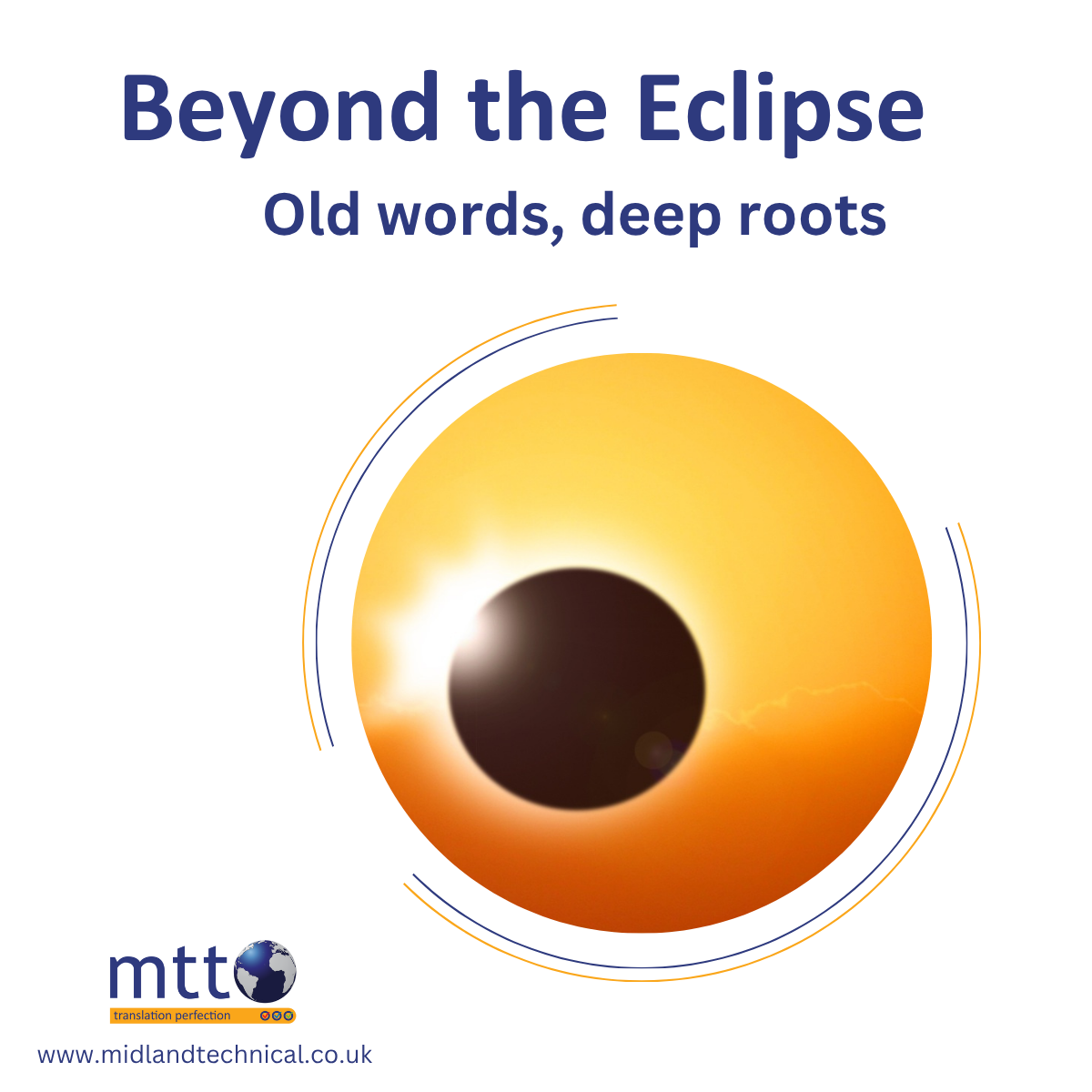
With today’s solar eclipse capturing our attention, we're reflecting on the importance of the sun and moon, not only in our lives, but also in the languages that we speak.
Did you know that many languages within the Indo-European family share common ancestral words for both the sun and the moon? From modern English to ancient Latin and Greek, and from the Baltic region to the Indian subcontinent, the words used for "sun" and "moon" in many languages can be traced back to the same linguistic origins.
While these words have evolved over thousands of years, linguists believe they originated from a reconstructed ancestral language known as Proto-Indo-European (PIE). It is thought that PIE was spoken between 4,000 and 6,000 years ago during the Late Neolithic and Early Bronze Age, across the steppes of Eastern Europe and Central Asia. As communities migrated, the language spread across vast areas of Europe and Asia, eventually developing into many of the languages spoken today.
Of course, not every word in the Indo-European language family shares a common root. As people travelled, settled in new regions, and encountered different cultures, languages naturally evolved, with new words emerging to describe new ideas, environments, and experiences. However the sun and moon were such fundamental concepts, those words had a tendency to endure.
As we take a moment to appreciate today's eclipse, it's fascinating to consider that the words for "sun" and "moon", spoken by millions of people around the world, still carry echoes of the same ancient linguistic heritage.
For your next translation project, contact our friendly team to see how we can help you.
+44 1562 748 778