
How do you name something new that you’ve never encountered before?
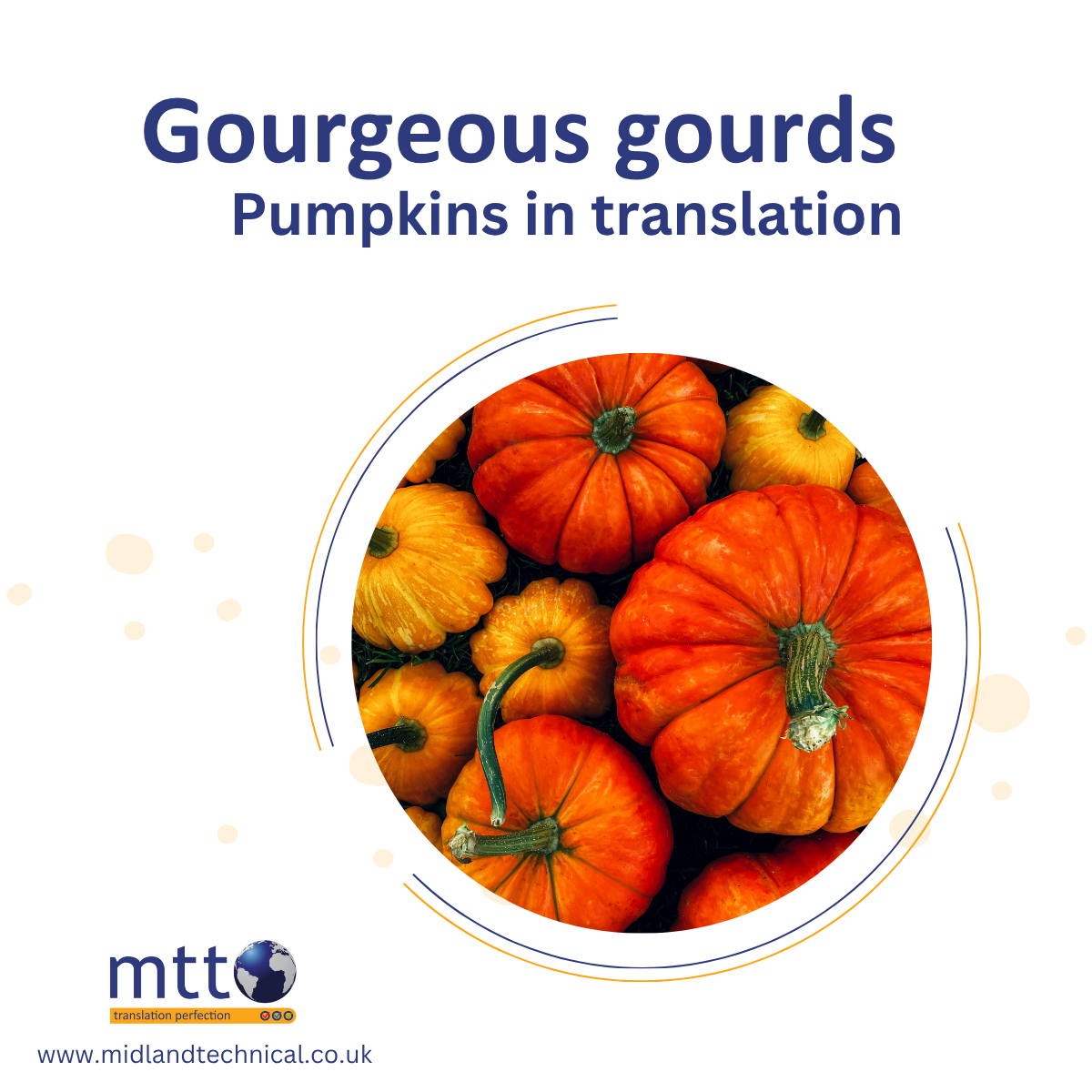
It’s Halloween so we’re celebrating that iconic Autumnal symbol of the spooky season, the pumpkin! Pumpkins are native to the Americas and weren’t introduced to Europe until the 16th century. On encountering this new thing, European languages had to adapt or borrow words to name the now familiar orange vegetable. It’s fascinating how much diversity there is between European languages!
The word ‘pumpkin’ is thought to be a borrowing from Greek, via old French, with an original meaning of ‘large melon’. Dutch ‘pompoen’ is similar and Swedish ‘pumpa’ was probably a borrowing from English.
However, many European languages took a different path. The Latin words for gourd ‘cucurbita’ and ‘cucutia’ are the roots of French ‘citrouille’, Italian ‘zucca’, Portuguese ‘abóbora’ and German ‘Kürbis’. Finnish ‘ Kurpitsa’ is a borrowing via Germanic and, more circuitously, so are Danish ‘græskar’ and Icelandic ‘grasker’. Taking a different route, Spanish ‘calabaza’ may come from Arabic ‘qar’a’ for ‘gourd’ thanks to Moorish influence.
Sadly, we don’t have space here to dig into Polish ‘dynia’, Hungarian ‘tök’ or Greek ‘kολοκύθα’!
Whatever you call your pumpkins, Happy Halloween!
For your next translation project contact our friendly team to see how we can help you.
+44 1562 748 778