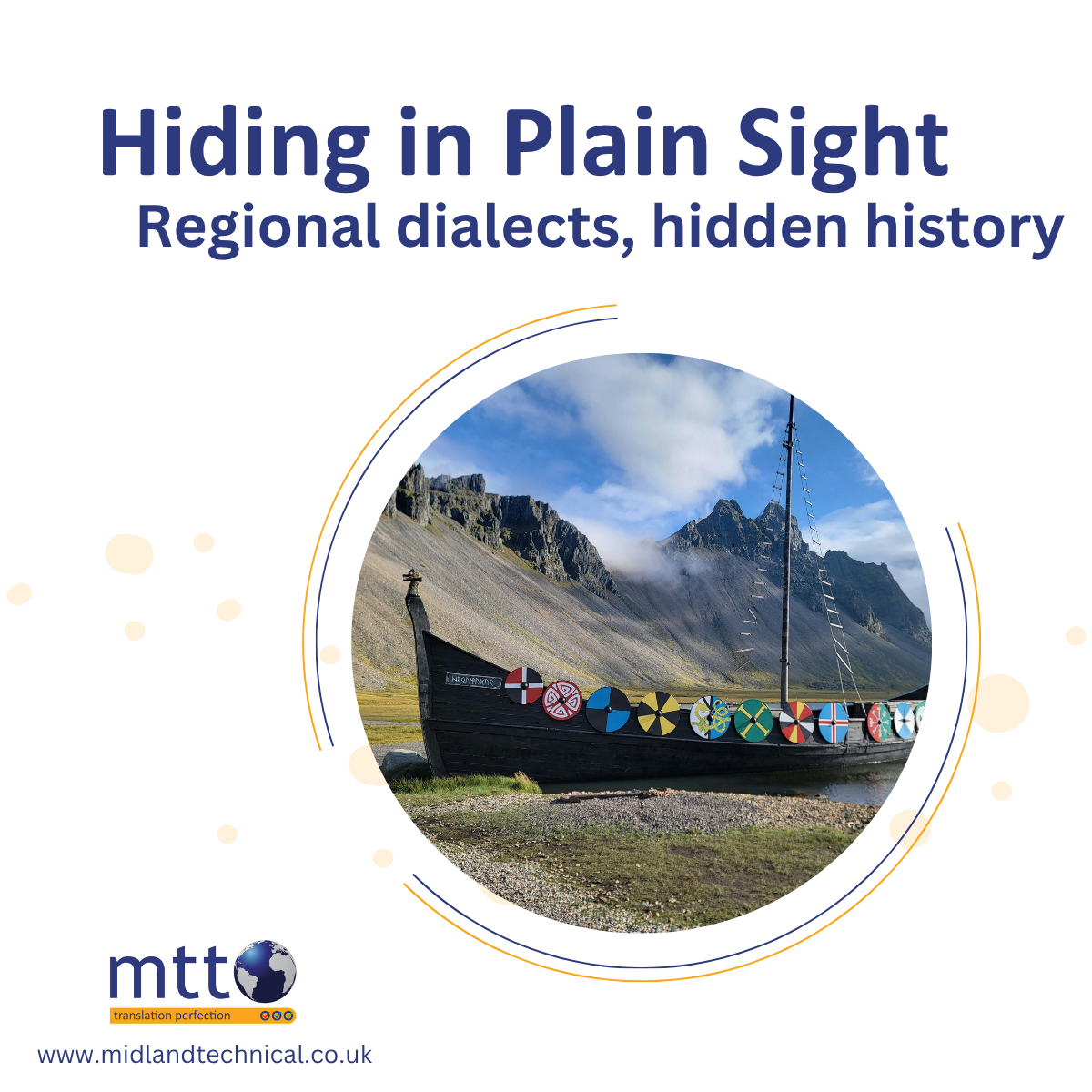

Hiding in plain sight; regional dialects & hidden history
A regional dialect is a variety of a language that is spoken in a specific geographic area. Unlike an accent, dialects are also characterised by differences in vocabulary and grammar.
The history of those word and grammar differences can reveal a lot about the history of the people and place connected to that dialect. For instance, ‘bairn’, meaning child, is commonly found in the dialects of Northern English, Scottish English and Scots. The word for ‘child’ in Norwegian, Danish, Swedish and Icelandic is ‘barn’. This is strikingly similar to ‘bairn’, and unsurprisingly, both ‘bairn’ and ‘barn’ come from the same source, Old Norse, the language of the Vikings!
The fact that ‘bairn’ continues to be used in the North of the British Isles, alongside other Norse-flavoured words such as ‘kirk’ (church), ‘fell’ (hill), ‘beck’ (stream) and ‘dale’ (valley), is a testament to the influence of the Vikings. The evidence of waves of Scandinavian settlement, which took place over a thousand years ago, can still be heard in dialects of the North today.
Most languages have national or regional varieties therefore when planning a translation, it is always worth considering the most appropriate language variety whether that’s Brazilian Portuguese or Belgian Dutch (Flemish).
For your next translation project contact our friendly team to see how we can help you.
+44 1562 748 778