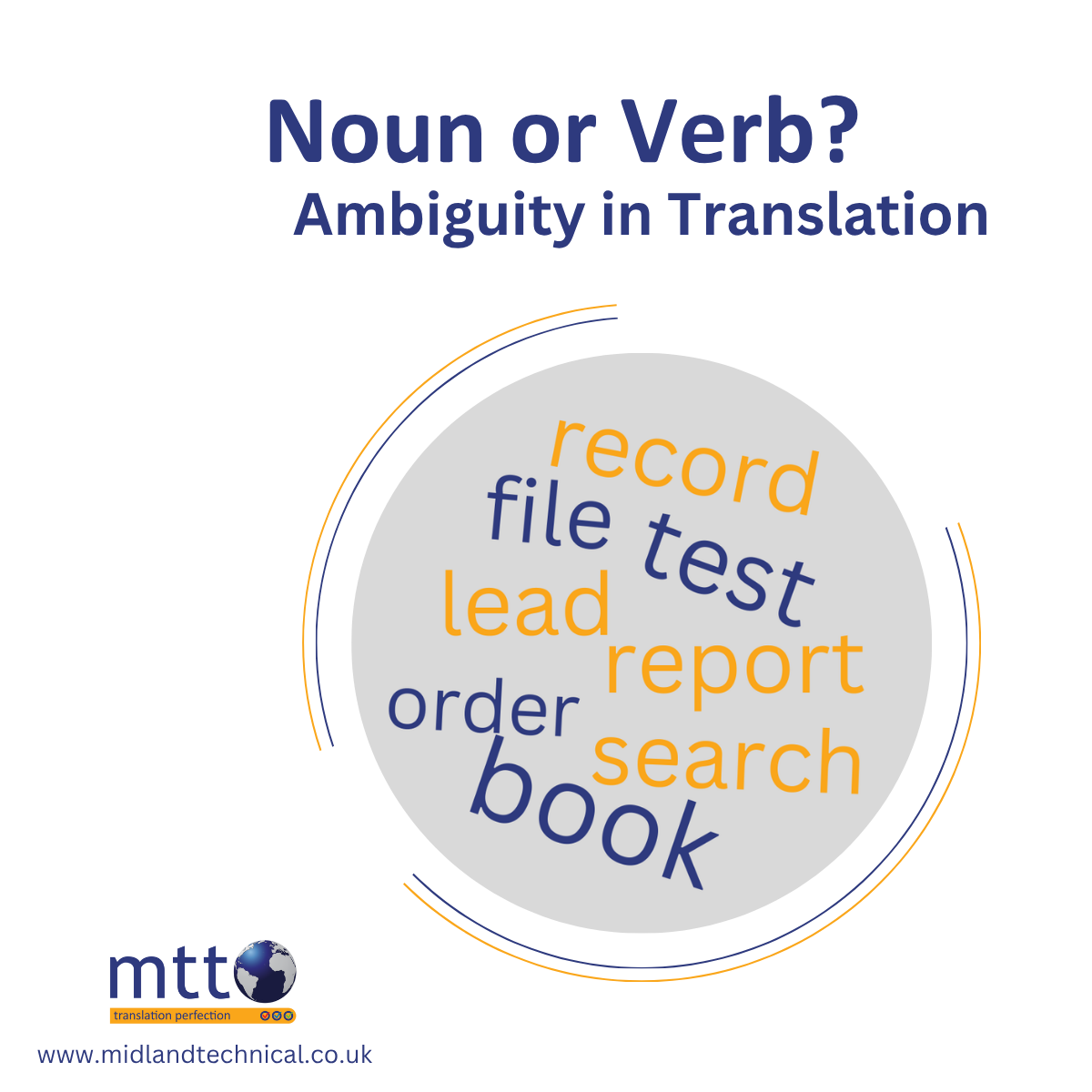

Is it a Noun or Verb? Tackling Ambiguity in Software Localisation
When translating short technical content such as software strings, one common challenge is part-of-speech ambiguity. In English, many words can function as more than one part of speech. Depending on the context, the same word may be a noun, a verb or even an adjective.
Common examples include record, lead, file, call, report, order and test. Each of these can be used either as a noun (an object, item or concept) or as a verb (an action or instruction). ‘Lead’ is the most ambiguous of all; it can be a metal, the graphite in a pencil, an advantage or clue, a verb meaning to guide or to cause.
In spoken English, pronunciation can sometimes help distinguish between meanings. Consider the difference between "a record" and "to record", where the stress falls on different syllables. However, this distinction disappears in writing and may offer no help at all with single syllable words such as test, where "a test" and "to test" look and sound identical in many contexts.
This creates a particular challenge in software localisation. User interface strings are often deliberately short and may be presented to translators with little or no surrounding context. When a translator encounters a word such as "RECORD" in isolation, it may be unclear whether it refers to:
• A noun: a record (an item of data)
• A verb: record (start recording)
In many target languages, this ambiguity does not exist. Different vocabulary, grammatical structures or word endings are often used to distinguish between nouns and verbs. As a result, the translator must first determine the intended part of speech before an accurate translation can be produced.
The most effective way to avoid errors is to provide translators with additional context. This may include screenshots, access to the software itself, user interface specifications or other reference materials. Even a simple visual reference can often clarify the intended meaning immediately.
Where visual context is not available, concise developer notes can be invaluable. For example: Record: This text appears on a button. When selected, the software begins recording.
A brief explanation such as this enables translators to choose the correct grammatical form and deliver a translation that is both accurate and natural for the end user. In technical translation, context is essential. The more information linguists receive about how text will be used, the more effectively they can resolve ambiguity and ensure a high-quality translation.
For your next software translation project, contact our friendly team to see how we can help you.
+44 1562 748 778